

CPP-Week2
- 1 CPP-Week7
- 2 CPP-Week6
- 3 CPP-Week5
- 4 C++ 位运算
- 5 CPP-Week4
- 6 CPP-Week3
- 7 CPP-Week2 本文
- 8 CPP-Week1
Lesson4 类与对象
“类”是 C++ 一个重要的概念,以至于 C++ 的原型就是“C with class”(带类的C)。
The central language feature of C++ is the class.
——A Tour of C++, third edition
4.0 面向对象编程
C++ 是一个面向对象 (Object-oriented) 的语言。它遵循面向对象编程 (Object-oriented programming, OOP) 的范式,以对象为中心设计编程语言。我们主要关注三个最重要的概念:封装 (Encapsulation)、继承 (Inheritance) 和多态 (Polymorphism)
在面向对象编程中,所有的实例都是对象,拥有其属性和行为。具有相同性质的对象,可以抽象为类 (Class)。
注意这里的“对象”和我们在 24.3.SP 所说的数据“对象”不一样。
在编程中,事物的属性由数据对象表示,行为由函数表示。
在面向对象编程中,重点在于创造拥有一组属性和行为的数据类型,其所指的“对象”是指具象化这些类型后得到的事物。
注意“对象”这个词是有点重载了,并且造成了一些困惑。在传统编程领域,对象是一块存储值的内存,仅此而已;在面向对象编程中,“对象”既包含传统编程中的数据对象,也包含我们上面所说的属性和行为。
——14.1 — Introduction to object-oriented programming – Learn C++
之后的教程中,OOP 中的“对象”将被称为“类对象”,以区分传统编程意义上的“对象”。
计算机纪事 1990:编程语言介绍了当时还是新鲜事物的面向对象编程。
4.1 封装
4.1.1 封装的意义
宽泛地讲,封装就是把一些数据和信息打包进一个单元里面。在C++中,封装特征的体现就是类。类是一组属性和行为的整合。
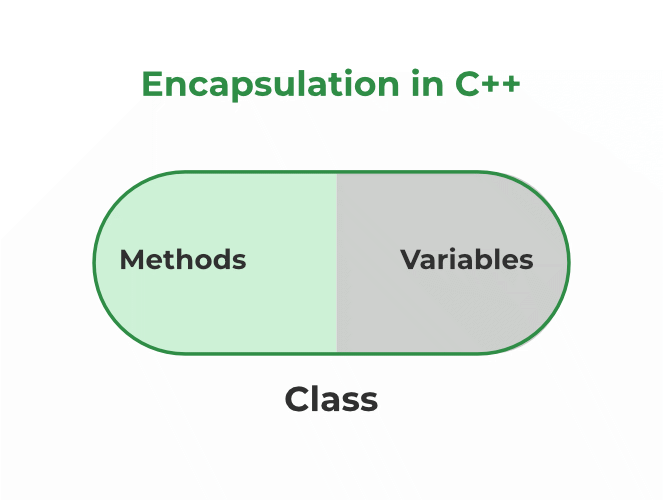
(来源:Encapsulation in C++ - GeeksforGeeks)
类是一个用户定义类型,可以用来表达程序源码中的某个概念,这样我们可以直接在代码中知道如何使用这个概念,而不需要依靠其他资料,比如设计文档、评论还有开发者的头脑。由一组精挑细选的类构建的程序比直接根据内置类型构建所有内容的程序更容易理解和正确执行。(就是不要重复造轮子)
一般来说,头文件中提供的很多东西就是类。
——A Tour of C++, third edition
我们先来写一个类吧。
如果需要定义一个类,我们需要:
class name { access specifier: // 访问权限 variables; // 属性 methods; // 行为}; // 注意最后还有一个‘;’例如,我们希望设计一个“圆”类,属性为半径,行为为求该圆周长,则:
class circle { public: int m_r; const double pi = 3.14; double calcCC(){ return 2 * pi * m_r; }};我们现在已经创建了一个类,对应一个抽象的“圆”。但我们还需要一个具体的实例来运用这些类,所以接下来我们创建一个类对象,并赋予属性:
circle r1;r1.m_r = 5;然后输出这个圆的周长:
printf("%.2f\n", r1.calcCC());运行一下:
31.40学生类设计展示:
class student { public: string name; int id; void show_info(){ printf("%s %d\n", name, id); }};#include <iostream>#include <string>
using namespace std; // 固定命名空间。工程上不建议使用!
class student{public: string name; // C++ 支持string类型 int id; void show_info() { cout << name << ' ' << id << '\n' << endl; // C++的流式输出。注意string类型用流式输出 }};
int main(void){ student s1, s2; s1.name = "张三"; s1.id = 114514; s2.name = "李四"; s2.id = 191981; s1.show_info(); s2.show_info(); getchar();}这里有一些C++的新语法没有介绍,可以参考:5.10 — Introduction to std::string – Learn C++;
<iostream>| Microsoft Learn
我们可以也可以利用类中的函数为类中的属性赋值:
class student { public: string N_name; void SetName (string name){ N_name = name; }};
int main(void){ student s1; s1.SetName("张三");}类中的函数可以在类外定义,定义时需要附上该函数的命名空间(可以理解为是类的作用域):
class student { public: string N_name;};void student::SetName (string name){ N_name = name;}类中的属性和行为统称为成员 (Member)。其中,属性称为“成员属性”或“成员变量”;行为称为“成员函数”或“成员方法”。
考虑命名数据成员时以
m_前缀开头,从而与局部变量、函数参数和成员函数的名称形成区别。——14.5 — Public and private members and access specifiers – Learn C++
4.1.2 类的访问权限
公园是公共场所,而住宅是私人的。你和其他人可以合法自由地进出公共场所,但只有住宅的成员以及被明确允许进入的人才能进入私人住宅。
——14.5 — Public and private members and access specifiers – Learn C++
类的一大特色就在于它的“数据保护”属性。通过为类成员设置不同的访问权限,我们得以保证数据操作是受控且安全的。
C++提供了三级访问权限:
public:类内成员可以访问,类外也可以访问。protected:类内成员可以访问,类外不能访问。该类的派生类也可以访问protected成员private:类内成员可以访问,类外不能访问。派生类不能访问private成员
访问控制基于类级别(而非对象级别)。这意味着一个类的成员函数可以访问同一类型的任何类对象的私有成员。
每次访问成员时,编译器都会检查该成员的访问级别。如果访问行为不被允许,编译器将生成编译错误。
class info { public: srting m_name; protected: string m_car; private: int m_card;};不指定访问权限时,类内成员默认为private成员。
我们定义的类的访问权限是给编译器看的。在运行时程序不会检查类的访问权限合法与否。
我们建议,将成员变量的访问权限设为private(或protected),成员函数的访问权限设为public。这被称为信息隐藏 (Information Hiding)。
这样做有以下好处:
-
自主可控的读写权限管理。
对于可读可写的成员变量,外界可以通过成员函数来写入与读取;对于只读的成员变量,我们可以不提供写入的成员函数;对于只写的成员变量,我们可以不提供读取的成员函数。
// r:read w:writeclass info {private:string m_name; // rwint m_card = 3586286477362; // rstring m_Idol; // wpublic:// rwvoid SetName(string name){m_name = name;}string GetName(){cout << m_name << '\n' << endl;}// rint GetCard(){cout << m_card << '\n' <<endl;}// wvoid SetIdol(string idol){m_Idol = idol;}}; -
写入数据前的有效性检查。
如果对输入的数据有要求,可以在写入时进行检查。
class info{private:int m_age;public:void SetAge(int age){if (age < 0 || age > 150){cout << "Invalid input, please retry.\n" << endl;return; // to end the function}m_age = age;}};
根据上面的原则,如果我们得到了一个类,我们只需要考虑它对外_能_做什么,而不必追究它内部的实现。前者就是我们所说的接口。
4.1.3 类和结构体的区别
学到这里是不是有一种既视感?我们在 C++ 写的类和在 C 语言写的结构体有十分甚至九分的相像,甚至共用一些名词!
从技术角度来看,结构体和类几乎相同。
在 C++ 中,类和结构体唯一的不同就在于其成员默认的访问权限不同。
类内成员的访问权限默认为private,而结构体内成员的访问权限默认为public。
struct st { int a;};
class cl { int b;};
int main(void){ st s1; s1.a = 10; cl c1; //c1.b = 10; // error: 无法访问}4.1.SP 类设计练习
SP.1 设计立方体类
设计目标:
- 设计一个立方体(Cube)类,求出立方体的面积和体积
- 分别用全局函数和成员函数判断两个立方体是否相等
样例:
class cube { // 属性 private: int m_L, m_W, m_H; // 立方体的三大属性:长、宽、高 // 行为 public: void set_pro (int L, int W, int H) { m_L = L; m_W = W; m_H = H; } int calc_s () { return 2 * (m_L * m_W + m_L * m_H + m_W * m_H); } int calc_v () { return m_L * m_W * m_H; } bool cmp_cube (cube& c) { return (m_L == c.m_L) && (m_W == c.m_W) && (m_H == c.m_H); } // 为了使用全局函数,需要再次输出 cube 类对象的属性,还需要写: int get_L () { return m_L; } int get_W () { return m_W; } int get_H () { return m_H; }};用法:
#include <iostream>using namespace std;
void cmp(cube &c1, cube &c2){ if ((c1.get_L() == c2.get_L()) && (c1.get_W() == c2.get_W()) && (c1.get_H() == c2.get_H())) { cout << "两个立方体相同" << "\n"; } else { cout << "两个立方体不同" << "\n"; }}
int main(void){ cube c1, c2; c1.set_pro(1, 2, 3); c2.set_pro(2, 3, 4); cout << "c1的面积是" << c1.calc_s() << '\n'; cout << "c1的体积是" << c1.calc_v() << '\n'; cmp(c1, c2); if (c1.cmp_cube(c2)) { cout << "两个立方体相同" << endl; } else { cout << "两个立方体不同" << endl; }}SP.2 设计点圆类
设计目标:
-
设计一个圆 (crircle) 类和一个点 (point) 类
-
判断圆和点的几何关系
点 和 的位置关系有三种: 在 外; 在 内; 在 上。
设 到圆心 的距离为 , 的半径为 ,则:
- 在 外 .
- 在 内 .
- 在 上 .
(来源:圆中的位置关系 | whk wiki)
样例:
class circle { //属性 private: int m_x, m_y, m_r;//圆的属性:圆心坐标(x,y),半径r //行为 public: void set_x (int x) { m_x = x; } void set_y (int y) { m_y = y; } void set_r (int r) { m_r = r; } int get_r () { return m_r; } int calc_cpd (point& p) { return sqrt(pow(m_x-p.m_x, 2)+pow(m_y-p.m_y, 2)); }};class point { // 属性 private: int m_x, m_y; // 圆的属性:坐标(x,y) // 行为 public: void set_x (int x) { m_x = x; } void set_y (int y) { m_y = y; }}用法:
#include <iostream>#include <cmath>using namespace std;
int main(void) { circle c1; point p1; c1.set_x(1); c1.set_y(2); c1.set_r(4); p1.set_x(6); p1.set_y(3); if (c1.calc_cpd(p1) == c1.get_r()) { cout << "点在圆上" << "\n"; } else if (c1.calc_cpd(p1) > c1.get_r()) { cout << "点在圆外" << "\n"; } else { cout << "点在圆内" << "\n"; }}4.2 对象的初始化和清理
在C++中,每个对象都会有初始化设置和对应的清理设置,因为使用一个没有初始化的对象或变量,后果是未知的。而在使用完对象后不加清理便销毁也是危险的。
4.2.1 聚合初始化
聚合体指的是可以包含多个数据成员的数据类型。有些聚合体允许允许成员具有不同的类型(例如结构体),而其他类型则要求所有成员必须是单一类型(例如数组)。
To simplify a bit, an aggregate in C++ is either a C-style array (17.7 — Introduction to C-style arrays), or a class type (struct, class, or union) that has:
- No user-declared constructors (14.9 — Introduction to constructors)
- No private or protected non-static data members (14.5 — Public and private members and access specifiers)
- No virtual functions (25.2 — Virtual functions and polymorphism)
The popular type
std::array(17.1 — Introduction to std::array) is also an aggregate.——13.8 — Struct aggregate initialization – Learn C++
根据本节的学习情况,我们只需要知道下列是聚合体:
- 数组
- 没有访问权限为
private或protected的非静态数据成员 且 没有用户声明的构造函数(下一小节介绍)的class和struct。
聚合体使用一种称为聚合初始化(列表初始化)的初始化形式,允许我们直接初始化聚合的数据成员。为此,我们需要提供一个初始化列表,一个用花括号{}括起来、以逗号分隔的值列表。比如:
struct Employee{ int id {}; int age {}; double wage {};};
int main(){ Employee frank = { 1, 32, 60000.0 }; // copy-list initialization using braced list Employee joe { 2, 28, 45000.0 }; // list initialization using braced list (preferred)
return 0;}自 C++11 后,一般变量也可以使用聚合初始化。这时一般变量只有一个数据成员,所以可且只可提供一个初始化值。
上面展示的是结构体的聚合初始化。那么类的聚合初始化呢?
这就有点难了。因为类成员的访问权限默认为private,并且最佳实践都建议我们对成员变量设为private,这时的类不再是一个聚合体,也就不能使用聚合初始化了。
Not allowing class types with private members to be initialized via aggregate initialization makes sense for a number of reasons:
- Aggregate initialization requires knowing about the implementation of the class (since you have to know what the members are, and what order they were defined in), which we’re intentionally trying to avoid when we hide our data members.
- If our class had some kind of invariant, we’d be relying on the user to initialize the class in a way that preserves the invariant.
——14.9 — Introduction to constructors – Learn C++
聚合初始化需要知道成员和它们的定义顺序是什么,这和类的“数据隐藏”的特征相违背;同时聚合初始化会覆盖成员的值。
4.2.2 构造函数
如何初始化类中private/protected的成员变量呢?C++ 提供了构造函数 (Constructor),可以帮助我们完成这一目标。
构造函数是一种特殊的成员函数,主要作用在于创建类对象时为对象的成员变量赋值。
Constructors are non-static member functions declared with a special declarator syntax, they are used to initialize objects of their class types.
——Constructors and member initializer lists - cppreference.com
构造函数是一个非静态成员函数,用以初始化类对象。
构造函数具有与类相同的名称,没有返回值,也不写void。(构造函数 (C++) | Microsoft Learn)
Constructors have no names and cannot be called directly. They are invoked when initialization takes place, and they are selected according to the rules of initialization.
——Constructors and member initializer lists - cppreference.com
构造函数没有自己的函数名,无法被用户直接调用。构造函数在初始化阶段被编译器按初始化顺序自动调用。
默认构造函数没有参数(所以也叫“无参构造”),按以下方式定义:
class_name () {} ;If all of the parameters in a constructor have default arguments, the constructor is a default constructor (because it can be called with no arguments).
——14.11 — Default constructors and default arguments – Learn C++
如果一个构造函数的所有参数都有默认值,则该构造函数是一个默认构造函数。
如果类中未声明构造函数,则编译器将调用隐式默认构造函数,后者是一个“空实现”,不做任何操作。
如果你依赖于隐式默认构造函数,请确保在类定义中初始化成员。如果没有初始化表达式,成员会处于未初始化状态。比如:
一般而言,即使不依赖于隐式默认构造函数,也最好以这种方式初始化成员。
但我们也可以定义带参数的构造函数(有参构造):
class_name c_func (parameter_list) : member_init_list { function_bodies }由此,构造函数也可以重载:
public: // Default constructor Box() {}
// Initialize a Box with equal dimensions (i.e. a cube) Box(int i) : m_width(i), m_length(i), m_height(i) {}// member init list
// Initialize a Box with custom dimensions Box(int width, int length, int height) : m_width(width), m_length(length), m_height(height) {}A class should only have one default constructor. If more than one default constructor is provided, the compiler will be unable to disambiguate which should be used.
——14.11 — Default constructors and default arguments – Learn C++
默认构造函数没有重载,不区分空参数表和全默认的参数表。一个类应该只有一个默认构造函数。
在调用用户定义的构造函数时,我们有三种调用方式:
-
函数调用风格
class_name c_func(10);⚠️调用默认构造函数并尝试使用括号时,系统会发出警告:
Terminal window warning C4930: prototyped function not called (was a variable definition intended?)我们可以将
myclass md();解释为函数声明或是对默认构造函数的调用。 因为 C++ 语法分析程序更偏向于声明,因此表达式会被视为函数声明。 此语句是最棘手的分析问题的示例。——构造函数 (C++) | Microsoft Learn
所以调用默认构造函数时,不要加括号!
-
类对象赋值风格
class_name c_func = class_name(10);class_name(10)是一个临时对象(Temporary class object, OR Anonymous object)。临时对象是一个没有名称且仅存在于单个表达式持续时间内的对象,用于表达式时,临时对象是一个右值。临时对象在定义点创建,并在定义它们的完整表达式的末尾被销毁。因为我们没有明确指定要构造的类型,编译器将根据函数参数推断出必要的类型,然后隐式地将
10转换为class_name对象。-
隐式的类对象赋值风格
class_name c_func = 10;//和class_name c_func = class_name(10);等价
-
4.2.3 拷贝构造函数
我们知道,在 C++ 中,有两种常用的函数传参方式:按值传递和按引用传递。这一节介绍传引用的构造函数。后者有专有名词,叫作“拷贝构造函数 (Copy constructor)”。
A copy constructor is a constructor that is used to initialize an object with an existing object of the same type. After the copy constructor executes, the newly created object should be a copy of the object passed in as the initializer.
——14.14 — Introduction to the copy constructor – Learn C++
拷贝构造函数执行后,新创建的类对象将被初始化为传入的已存在的类对象。
拷贝构造函数按如下方式定义:
// Copy constructorFraction(const Fraction& fraction) // Initialize our members using the corresponding member of the parameter : m_numerator{ fraction.m_numerator } , m_denominator{ fraction.m_denominator }{ std::cout << "Copy constructor called\n"; // just to prove it works // do not write it}实际上就是传入要拷贝类对象的引用,通过引用访问类对象获取数据,然后将数据初始化给新的类对象。
It is a requirement that the parameter of a copy constructor be an lvalue reference or const lvalue reference. Because the copy constructor should not be modifying the parameter, using a const lvalue reference is preferred.
——14.14 — Introduction to the copy constructor – Learn C++
拷贝构造函数的参数必须是一个
const引用,以免意外污染源数据。
A copy constructor should not do anything other than copy an object. This is because the compiler may optimize the copy constructor out in certain cases. If you are relying on the copy constructor for some behavior other than just copying, that behavior may or may not occur.
——14.14 — Introduction to the copy constructor – Learn C++
除了拷贝操作以外,不要在拷贝构造函数里定义任何操作,因为特定的编译器会优化掉拷贝构造函数,然后你定义的其他行为就被编译器忽略掉了。
如果用户没有提供拷贝构造函数,编译器会自动提供。编译器提供的函数称为“隐式拷贝构造函数”
If you do not provide a copy constructor for your classes, C++ will create a public implicit copy constructor for you. By default, the implicit copy constructor will do memberwise initialization. This means each member will be initialized using the corresponding member of the class passed in as the initializer. In the example below,
fCopy.m_numeratoris initialized usingf.m_numerator, andfCopy.m_denominatoris initialized usingf.m_denominator.——14.14 — Introduction to the copy constructor – Learn C++
默认情况下,隐式拷贝构造函数将执行成员初始化。这意味着每个成员将被初始化为传入类中相应的成员的数据。
同样有三种调用风格:
-
函数调用风格
class_name p1 (p2); -
类对象赋值风格
class_name p1 = class_name(p2);-
隐式类对象赋值风格
class_name p1 = p2;
-
使用拷贝构造函数创建的对象不能用于初始化临时对象(或者作为左值)。例如:
Fraction f{5, 3}; // Calls Fraction(int, int) constructorFraction fCopy{f}; // Calls Fraction(const Fraction&) copy constructorFraction f1 = Fraction(fCopy);Fraction f2 = Fraction(f1);//Fraction(f2);// error: redeclaration of 'Fraction f2'//Fraction(f2) = 10;// error: redeclaration of 'Fraction f2'因为C++的分析程序更倾向于将Fraction(f2)视为函数声明。
什么时候会调用拷贝构造函数呢?一般有三种情况:
- 使用一个已经创建完毕的对象来初始化一个新对象
- 按值传递的方式给函数传参
- 按值返回局部对象
我们以一个示例程序来说明后两点:
#include <iostream>
class Fraction{private: int m_numerator{ 0 }; int m_denominator{ 1 };
public: // Default constructor Fraction(int numerator = 0, int denominator = 1) : m_numerator{ numerator }, m_denominator{ denominator } { }
// Copy constructor Fraction(const Fraction& fraction) : m_numerator{ fraction.m_numerator } , m_denominator{ fraction.m_denominator } { std::cout << "Copy constructor called\n"; }
void print() const { std::cout << "Fraction(" << m_numerator << ", " << m_denominator << ")\n"; }};
void printFraction(Fraction f) // f is pass by value{ f.print();}
Fraction generateFraction(int n, int d){ Fraction f{ n, d }; return f;}
int main(){ Fraction f2 { generateFraction(1, 2) }; // Fraction is returned using copy constructor
printFraction(f2); // f2 is copied into the function parameter using copy constructor
return 0;}- 首先,程序先执行
generateFraction函数,对类对象f初始化,调用一次默认构造函数;然后在main函数中创建临时类对象,调用一次拷贝构造函数,将f传出函数(f之后被销毁)。 - 然后,临时对象用于初始化类对象
f2,调用一次拷贝构造函数。 - 最后,当将
f2传递给printFraction时,拷贝构造函数第三次被调用。
一种可能的输出是:
Copy constructor calledCopy constructor calledCopy constructor calledFraction(1, 2)如果在特定开发环境中运行该程序,可能会发现复制构造函数只调用了两次。这是一种称为复制省略的编译器优化。
4.2.4 深拷贝和浅拷贝
浅拷贝 (Shallow copy)就是简单的赋值拷贝操作。这是C++编译器提供的默认拷贝构造函数所使用的拷贝方式。
Because C++ does not know much about your class, the default copy constructor it provides use a copying method known as a memberwise copy (also known as a shallow copy). This means that C++ copies each member of the class individually.
——21.13 — Shallow vs. deep copying – Learn C++
In shallow copy, an object is created by simply copying the data of all variables of the original object.
——Shallow Copy and Deep Copy in C++ - GeeksforGeeks
浅拷贝通过简单地复制原始对象所有变量的数据来创建一个对象。
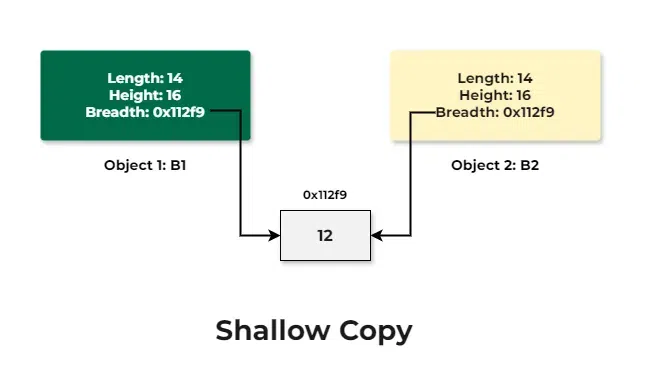
当类中没有涉及指针和动态内存分配时,这种拷贝方式十分有效。但一旦和指针扯上关系,浅拷贝就有很多不足:
- 浅拷贝只复制数值。在复制指针变量时,由于只拷贝了地址,副本和原本的指针变量会指向同一个内存位置(如上图所示),在副本中的修改也会反映到原本上。这会导致意料外的数据污染。
- 单纯的数值更改还不是最恼人的。假如这个副本由于某种原因(如生存期)被销毁,根据上面的说法,其中的指针指向的内存位置也会被回收,原本的指针变量忽然变成了野指针!程序中出现了一个未定义行为!
Doing a shallow copy on pointer values in a copy constructor is almost always asking for trouble.
——21.13 — Shallow vs. deep copying – Learn C++
在复制构造函数中对指针值进行浅拷贝几乎总是自找麻烦。
所以,涉及到指针的拷贝时,我们需要使用深拷贝 (Deep copy)
深拷贝会在堆区申请空间,进行拷贝操作。这种拷贝不仅包括了原类对象内部的数据,也包括和该对象有关的外部数据。这就是“深拷贝”所说的“深”:不仅拷贝数值,还拷贝关系。
A deep copy allocates memory for the copy and then copies the actual value, so that the copy lives in distinct memory from the source. This way, the copy and source are distinct and will not affect each other in any way.
——21.13 — Shallow vs. deep copying – Learn C++
深拷贝为副本分配内存,然后复制实际值,这样副本就存在于与原本不同的内存中。副本和原本相互独立,彼此之间不会以任何方式产生影响。
In Deep copy, an object is created by copying data of all variables, and it also allocates similar memory resources with the same value to the object.
——Shallow Copy and Deep Copy in C++ - GeeksforGeeks
深拷贝时,程序会为副本类对象分配和原本相近的内存资源。
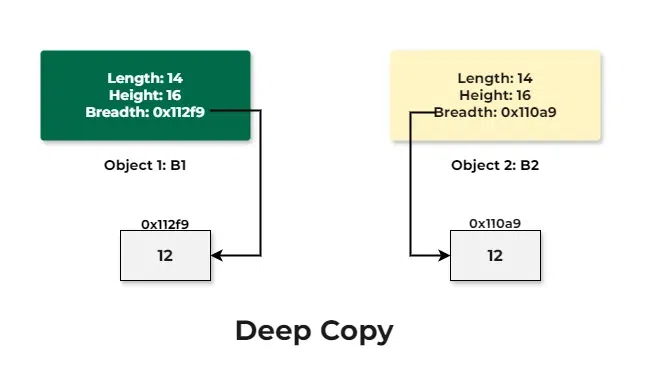
编译器不生成可以深拷贝的构造函数。为了进行深拷贝,我们需要自己写一个拷贝构造函数。
#include <iostream>using namespace std;
// Box Classclass box {private: int length; int* breadth; int height;
public: // Constructor box() { breadth = new int; }
// Function to set the dimensions of the Box void set_dimension(int len, int brea, int heig) { length = len; *breadth = brea; height = heig; }
// Function to show the dimensions of the Box void show_data() { cout << " Length = " << length << "\n Breadth = " << *breadth << "\n Height = " << height << endl; }
// Parameterized Constructors for for implementing deep copy box(box& sample) { length = sample.length; breadth = new int; *breadth = *(sample.breadth); height = sample.height; }
};
// Driver Codeint main(){ // Object of class first box first;
// Set the dimensions first.set_dimension(12, 14, 16);
// Display the dimensions first.show_data();
// When the data will be copied // then all the resources will also get allocated to the new object box second = first;
// Display the dimensions second.show_data();
return 0;}实施深拷贝时,我们为需要用到指针的成员分配自动内存(new),然后将原成员数据传递给副本。对于非指针的成员,浅拷贝已经足够使用。
Classes in the standard library that deal with dynamic memory, such as std::string, handle all of their memory management. So instead of doing your own memory management, you can just initialize or assign them like normal fundamental variables!
——21.13 — Shallow vs. deep copying – Learn C++
优先使用标准库中的类,而不是自己进行内存管理。比如C++中的std::string。顺带一提,如果使用C语言风格处理字符串,那么用户定义的拷贝构造函数可能长这样:
// first we need to deallocate any value that this string is holding!delete[] m_data;
// because m_length is not a pointer, we can shallow copy itm_length = source.m_length;
// m_data is a pointer, so we need to deep copy it if it is non-nullif (source.m_data)//check to make sure source even has a string{ // allocate memory for our copy m_data = new char[m_length];
// do the copy for (int i{ 0 }; i < m_length; ++i) m_data[i] = source.m_data[i];}else m_data = nullptr;}以下表格展示了浅拷贝和浅拷贝的区别:
| No. | Shallow Copy | Deep copy |
|---|---|---|
| 1. | When we create a copy of object by copying data of all member variables as it is, then it is called shallow copy | When we create an object by copying data of another object along with the values of memory resources that reside outside the object, then it is called a deep copy |
| 2. | A shallow copy of an object copies all of the member field values. | Deep copy is performed by implementing our own copy constructor. |
| 3. | In shallow copy, the two objects are not independent | It copies all fields, and makes copies of dynamically allocated memory pointed to by the fields |
| 4. | It also creates a copy of the dynamically allocated objects | If we do not create the deep copy in a rightful way then the copy will point to the original, with disastrous consequences. |
(来源:Shallow Copy and Deep Copy in C++ - GeeksforGeeks)
4.2.5 析构函数
假设我们有一段程序,使用类存储一些需要发送到服务器的数据。由于网络连接成本较高,所以我们希望延迟提交,先积攒一些数据再打包发送。程序设计的类可能是这样的:
// This example won't compile because it is (intentionally) incompleteclass NetworkData{private: std::string m_serverName{}; DataStore m_dataQueue{};
public: NetworkData(std::string_view serverName)// Set server : m_serverName { serverName } { }
void addData(std::string_view data)// Collect data { m_dataQueue.add(data); }
void sendData() { // connect to server // send all data // clear data }};
int main(){ NetworkData n("someipAddress");
n.addData("somedata1"); n.addData("somedata2");
n.sendData();
return 0;}这样设计有一个问题:如果用户由于某些原因提前退出了程序,那么当前所有未发送的数据包将全部丢失!我们当然可以补救,比如说设置一些判断条件,达到条件强制发送数据。但如果这是一个开发中项目的模块呢?模块间的关系会越来越复杂,我们无法确保程序每次退出前都能运行到n.sendData()。
因此我们需要在对象被销毁前先进行清理工作,先做完自己需要做的事之后再销毁。
To generalize this issue, classes that use a resource (most often memory, but sometimes files, databases, network connections, etc…) often need to be explicitly sent or closed before the class object using them is destroyed. In other cases, we may want to do some record-keeping prior to the destruction of the object, such as writing information to a log file, or sending a piece of telemetry to a server. The term “clean up” is often used to refer to any set of tasks that a class must perform before an object of the class is destroyed in order to behave as expected.
——15.4 — Introduction to destructors – Learn C++
使用资源(通常是内存,但有时是文件、数据库、网络连接等)的类通常需要在销毁使用它们的类对象之前被显式地发送或关闭。在其他情况下,我们可能在对象被销毁之前进行一些记录。术语“清理”通常用来指代一个类在销毁其对象之前必须执行的一系列任务,以确保按预期行为。
C++中提供了**析构函数(Destructor)**用以解决类对象的清理问题。它的设计目的就是允许类在对象被销毁之前执行任何必要的清理操作。
和构造函数类似,析构函数是一种特殊的成员函数。当非聚合类的对象被销毁时,该函数会被自动调用。
析构函数的声明:
~d_func() {function_bodies}- 和构造函数一样,析构函数必须与类名相同,前面加一个波浪号(
~)。没有返回值,也不写void。 - 析构函数严格不接受任何参数,因此也不支持重载。一个类只能有一个析构函数。这和构造函数不一样。
Generally you should not call a destructor explicitly (as it will be called automatically when the object is destroyed), since there are rarely cases where you’d want to clean up an object more than once.
Destructors may safely call other member functions since the object isn’t destroyed until after the destructor executes. ——15.4 — Introduction to destructors – Learn C++
一般情况下,不应该显式调用析构函数,因为对象被销毁时它将自动被调用,而且很少会有需要多次清理对象的情况。
析构函数可以安全地调用其他成员函数,因为对象在析构函数执行后才被销毁。
If a non-aggregate class type object has no user-declared destructor, the compiler will generate a destructor with an empty body. This destructor is called an implicit destructor, and it is effectively just a placeholder.
If your class does not need to do any cleanup on destruction, it’s fine to not define a destructor at all, and let the compiler generate an implicit destructor for your class. ——15.4 — Introduction to destructors – Learn C++
如果用户没有定义析构函数,那么编译器会生成一个隐式析构函数。隐式析构函数是一个空函数,什么也不做。如果确定你的类在析构时不需要进行任何清理工作,则无需定义析构函数。
现在我们可以使用析构函数来优化开头的示例类了:
// This example won't compile because it is (intentionally) incompleteclass NetworkData{private: std::string m_serverName{}; DataStore m_dataQueue{};
public: NetworkData(std::string_view serverName) : m_serverName { serverName } { }
~NetworkData() { sendData(); // make sure all data is sent before object is destroyed }
void addData(std::string_view data) { m_dataQueue.add(data); }
void sendData() { // connect to server // send all data // clear data }};
int main(){ NetworkData n("someipAddress");
n.addData("somedata1"); n.addData("somedata2");
return 0;}NetworkData 对象将始终在被销毁之前发送它拥有的任何数据!
4.2.6 构造函数调用规则
默认情况下,C++编译器会为一个类添加至少三个函数:
- 默认构造函数
- 默认析构函数
- 默认拷贝构造函数
如果用户定义了三个函数中的一个,那么编译器的添加行为会发生变化:
- 如果用户定义了有参构造函数,则编译器不再提供默认构造函数,但是会提供默认拷贝构造函数
- 如果用户定义了拷贝构造函数,则编译器不再提供任何构造函数。
If a class requires a user-defined destructor, a user-defined copy constructor, or a user-defined copy assignment operator, it almost certainly requires all three.
——The rule of three/five/zero - cppreference.com
根据“三法则”,如果你需要自己定义构造函数、拷贝构造函数或析构函数中的任意一个,那么另外两个函数多半也需要你来定义(而不是编译器默认提供)。
根据C.20: If you can avoid defining default operations, do,如果标准库提供的类自带构造函数、拷贝构造函数和析构函数,就不要自己去定义它们。
4.2.7 成员初始化列表
我们在定义有参构造函数时已经提到member_init_list(成员初始化列表)。下面我们讨论初始化规则。
一个完整的有参构造函数示例如下:
Foo(int x, int y) : m_x { x }, m_y { y } // here's our member initialization list { std::cout << "Foo(" << x << ", " << y << ") constructed\n"; }成员初始化列表定义在构造函数参数之后。它以冒号(:)开头,然后列出每个要初始化的成员以及该变量的初始化值,成员和值之间用逗号(,)分隔。
在这里必须使用聚合初始化形式(最好使用花括号,但括号也行)(使用等号的初始化在这里不起作用)。另外请注意,成员初始化列表不以分号结尾。
当实例化 foo 时,初始化列表中的成员使用指定的初始化值进行初始化。在这种情况下,成员初始化列表将 m_x 初始化为 x 的值(即 6 ),并将 m_y 初始化为 y 的值(即 7 )。然后执行构造函数的主体。
C++为程序员提供了自定义列表格式的自由。常见的书写格式有:
Foo(int x, int y) : m_x { x }, m_y { y }{}Foo(int x, int y) : m_x { x }, m_y { y }{}Foo(int x, int y) : m_x { x }//or : m_x { x }, m_y{ y } , m_y { y }{}这种自由是由C++标准所允许的,因为编译器在初始化时不按构造函数提供的成员初始化列表顺序初始化。成员初始化列表中的成员总是按照在类内部定义的顺序进行初始化。例如:
class Foo{private: int m_x{}; int m_y{};
public: Foo(int x, int y) : m_y { std::max(x, y) }, m_x { m_y } // issue on this line { }
void print() const // const表示函数不会修改成员变量。编译器会检查。 { std::cout << "Foo(" << m_x << ", " << m_y << ")\n"; }};在Foo中,我们本来期望函数先初始化m_y,再初始化m_x,但实际运行起来却不是这样:
Foo(-858993460, 7) # an example output程序先初始化了m_x,但这个时候用来初始化它的m_y自己却没有初始化,于是m_x被初始化为了一个奇怪的值。
To help prevent such errors, members in the member initializer list should be listed in the order in which they are defined in the class. Some compilers will issue a warning if members are initialized out of order.
It’s also a good idea to avoid initializing members using the value of other members (if possible). That way, even if you do make a mistake in the initialization order, it shouldn’t matter because there are no dependencies between initialization values.
——14.10 — Constructor member initializer lists – Learn C++
为了帮助防止此类错误,成员初始化列表中的成员应按照它们在类中定义的顺序列出。避免使用其他成员的值来初始化成员(如果可能的话)也是一个好主意。
成员可以通过几种不同的方式初始化:
- 如果一个成员在成员初始化列表中列出,则使用该初始化值
- 否则,如果成员被默认成员初始化(default member initializer),则使用该初始化值
- 否则,成员将被默认初始化(对于基本数据类型来说,这意味着它未被初始化(no initializer))。
这意味着如果一个成员在构造函数的成员初始化器列表中列出,同时被默认成员初始化,则成员初始化器列表的值优先。
这里是一个展示所有三种初始化方法的示例:
#include <iostream>
class Foo{private: int m_x {}; // default member initializer (will be ignored) int m_y { 2 }; // default member initializer (will be used) int m_z; // no initializer
public: Foo(int x) : m_x { x } // member initializer list { std::cout << "Foo constructed\n"; }
void print() const { std::cout << "Foo(" << m_x << ", " << m_y << ", " << m_z << ")\n"; }};
int main(){ Foo foo { 6 }; foo.print();
return 0;}-
当构造
foo时,只有m_x出现在成员初始化列表中,因此m_x首先被初始化为6。 -
m_y不在成员初始化列表中,但它被默认成员初始化,因此它被初始化为2。 -
m_z既不在成员初始化列表中,也没有被默认成员初始化,因此它使用默认初始化。
在定义构造函数时,我们也可以在函数体内为成员赋值:
class Foo{private: int m_x { 0 }; int m_y { 1 };
public: Foo(int x, int y) { m_x = x; // this is an assignment, not an initialization m_y = y; // this is an assignment, not an initialization }尽管在这个情况下,这将产生预期的结果,但在需要初始化成员(例如对于 const 或引用的数据成员)的情况下,赋值将不起作用。因此优先使用成员初始化列表来初始化成员,而不是在构造函数体中分配值。
新手程序员有时会在构造函数体中为成员变量赋值。
4.3 类对象作为类成员
C++类中的成员可以是另一个类的对象,我们称该成员为对象成员 (Members that point to or reference objects),该过程称为类的聚合 (Aggergation)。
To qualify as an aggregation, a whole object and its parts must have the following relationship:
- The part (member) is part of the object (class) 该(成员)部分属于类(对象)的一部分
- The part (member) can (if desired) belong to more than one object (class) at a time 该(成员)部分可以同时属于几个类(对象)
- The part (member) does not have its existence managed by the object (class) 该(成员)部分的存在不由类(对象)管理
- The part (member) does not know about the existence of the object (class) 该(成员)部分始终不知道类(对象)的存在
In an aggregation, we also add parts as member variables. However, these member variables are typically either references or pointers that are used to point at objects that have been created outside the scope of the class. (成员)部分可以作为成员变量添加。这些成员变量通常是引用或指针,用于指向在类作用域之外创建的对象。
例如:
class A { ...}class B { A a; ...}类B中有对象a作为成员,A为对象成员。
现在来看看这个示例程序:
#include <iostream>#include <string>#include <string_view>
class Teacher{private: std::string m_name{};
public: Teacher(std::string_view name) : m_name{ name } { }
const std::string& getName() const { return m_name; }};
class Department{private: const Teacher& m_teacher; // This dept holds only one teacher for simplicity, but it could hold many teachers
public: Department(const Teacher& teacher) : m_teacher{ teacher } { }};
int main(){ // Create a teacher outside the scope of the Department Teacher bob{ "Bob" }; // create a teacher
{ // Create a department and use the constructor parameter to pass the teacher to it. Department department{ bob };
} // department goes out of scope here and is destroyed
// bob still exists here, but the department doesn't std::cout << bob.getName() << " still exists!\n";
return 0;}- 首先,
bob独立于department创建。bob调用一次构造函数 - 然后,
bob被传递给department的拷贝构造函数。department调用一次拷贝构造函数 - 当
department被销毁时,m_teacher引用被销毁。department调用一次析构函数 - 但
bob本身并未被销毁,因此它仍然存在,直到在main()中独立销毁。这时bob调用一次
对象成员“早出晚归”,构造先于使用它的类,析构晚于使用它的类。这从类的聚合的性质来看很自然。
对象成员的内存释放不由调用它的类管理,所以如果忘记了(或无法)在类外释放对象成员的内存,就可能导致内存泄露。
4.4 静态成员
当数据成员被static修饰时,该成员即为静态成员 (Static Member)。
When a data member is declared as static, only one copy of the data is maintained for all objects of the class. Static data members are not part of objects of a given class type.
——Static Members (C++) | Microsoft Learn
Inside a class definition, the keyword static declares members that are not bound to class instances. Static members of a class are not associated with the objects of the class: they are independent variables with static or thread(since C++11) storage duration or regular functions.
——static members - cppreference.com
一旦成员被static修饰,那么该成员便不再独属于一个类对象,而是成为一个独立的对象/函数,提供给所有用到该成员的类对象。换句话说,这是一个共享的成员。
静态成员分为两类:
-
静态成员变量
- 所有类对象共享一份数据
- 在编译阶段已经分配内存
- 类内声明,类外初始化
静态成员变量与任何对象无关,即使没有定义类对象,成员依然存在。这个成员在整个程序中仅有一个,具有静态存储期。
——static members - cppreference.com
因为静态成员变量本质上就是全局变量,所以你必须在类外全局范围内显式定义(可以同时初始化)静态成员
-
静态成员函数
- 所有类对象共享一个函数
- 静态成员函数只能访问静态成员变量,不能访问非静态成员变量。
静态成员函数同样和任何对象无关。在使用指针时,应将静态成员函数视为普通的函数,而不是成员函数。
如果想要使用静态成员,有三种方式:::、.和->。
示例:
class X { static int n; }; // declaration (uses 'static'), incomplete typeint X::n = 1; // definition (does not use 'static'), complete type类内的静态成员声明不是定义。类内声明时,静态成员只有不完整的类型,需要在类外定义时补充类型。
::是作用域解析运算符。
推荐使用类名和作用域解析运算符(::)访问静态成员。这样不需要创建类成员也可以使用静态成员。
静态成员定义不受访问权限限制:即使它在类中声明为private(或protected),我们也可以定义和初始化其值。
由于静态成员依然遵循类成员访问规则,因此对于private和protected的静态成员,我们在类外依然不能直接访问(除了定义和初始化)
文章分享
如果这篇文章对你有帮助,欢迎分享给更多人!